Reading

At Lingfield, we aim to foster a lifelong love of reading by developing confident, fluent readers who can access, understand and enjoy a wide range of texts. We want every child to see themselves as a reader and to recognise reading as the foundation for all learning.

In Early Years and Key Stage 1, children build strong foundational knowledge through the Read Write Inc programme, where they develop secure phonics, decoding skills and early comprehension. Carefully matched texts enable children to practise fluency, accuracy and expression, ensuring reading skills are embedded securely.

As children move into Key Stage 2, they deepen their comprehension skills through high-quality whole-class texts, explicit vocabulary instruction and structured discussion. Children learn to retrieve, infer, summarise and evaluate, while comparing texts, analysing language and considering authorial intent. Reading is taught as an active process, enabling children to monitor understanding and ask questions.

Through a carefully sequenced progression from decoding to fluency to deeper comprehension, children become fluent, thoughtful and independent readers by the end of Key Stage 2, equipped to access the full breadth of the curriculum and beyond.

Reading improves all of a child’s literacy skills and can offer them a lifetime of enjoyment and learning. At Lingfield Primary School we aim to promote a love of reading and feel that children discovering books and how to use and enjoy them is crucial to their development. Through individual reading, group reading and whole class work in RWInc, and then Reading Wokshop lessons, they read around a variety of genres and themes. We aim to give children to high quality reading experiences that support and challenge them to delve further into the texts they are encountering and develop confidence in being able to discuss them.

At Lingfield Primary School, we believe that reading is the key that unlocks the entire curriculum. Our approach to reading is carefully sequenced, evidence-informed, and rooted in the understanding that successful reading depends on both accurate word reading and strong language comprehension.

Our reading progression is informed by:

  • Read Write Inc. (RWI) as our chosen systematic synthetic phonics (SSP) programme
  • The EEF Reading Comprehension House, which emphasises secure foundations of word reading and language comprehension
  • Christopher Such’s research-informed work on reading development, particularly the progression from decoding, to fluency, to comprehension, and the different lesson structures that support this journey


We explicitly teach reading through a phased and cumulative model:

  1. Decoding (accuracy)
  2. Fluency (automaticity and prosody)
  3. Comprehension (making meaning)


These elements are not isolated; they overlap and reinforce one another as children become increasingly skilled readers.


Phase 1: Learning to Decode – Foundations of Reading


Children begin learning to read through Read Write Inc., a systematic synthetic phonics programme. This ensures that all children are taught:

  • Grapheme–phoneme correspondences
  • Oral blending and segmenting
  • Reading words by sounding out and blending
  • Early spelling linked directly to phonics knowledge


Teaching is:

  • Highly structured and cumulative
  • Matched closely to pupils’ phonics knowledge
  • Underpinned by frequent assessment and targeted support


At this stage, the primary focus is accuracy. Children are learning how the written code works.


Phase 2: Developing Fluency – Bridging Decoding and Comprehension


Once children can confidently decode with growing accuracy, teaching shifts to prioritise fluency. Fluency acts as the bridge between word reading and comprehension, as outlined in the EEF Reading House.

Fluency includes:

  • Accuracy
  • Automaticity (reading without conscious decoding effort)
  • Appropriate pace
  • Prosody (expression, phrasing, intonation)


Fluent readers free up cognitive capacity to focus on meaning.

To support children’s progression as readers, we use three distinct but connected lesson types.

1. Fluency Lessons


Purpose: To develop automatic, expressive reading so pupils can access meaning.

Key features:

  • Short, focused sessions
  • Repeated reading of carefully chosen texts
  • Explicit modelling of fluent reading by the teacher
  • Choral reading, echo reading and paired reading
  • Attention to phrasing, punctuation and expression


When used:

  • Once decoding is secure
  • Continues throughout primary school


Fluency lessons are a non-negotiable foundation for later comprehension work.


2. Close Reading Lessons


Purpose: To deepen understanding of how a text works.

Key features:

  • Short extracts or complete texts
  • Rereading for different purposes
  • Teacher-led questioning
  • Focus on vocabulary, sentence structure, cohesion and authorial choices


When used:

  • Once pupils can read the text fluently
  • To build analytical reading skills

3. Extended Reading Lessons


Purpose: To develop stamina, enjoyment and deeper comprehension across longer texts.

Key features:

  • Sustained engagement with a whole text
  • Opportunities for discussion and response
  • Focus on meaning, themes, character, and authorial intent
  • Balance of teacher guidance and pupil independence


When used:

  • When fluency and basic comprehension are secure
  • Increasingly across KS2


Progression Between Lesson Types

The lesson types are developmental and cumulative:

  • Fluency lessons underpin everything
  • Close reading builds depth once pupils can read fluently
  • Extended reading builds stamina, independence and pleasure


Pupils may move flexibly between lesson types depending on the text and their needs, but fluency remains a constant priority.

The table below summarises how decoding, fluency, comprehension, and independence develop across the school. This overview is designed to make progression explicit for staff, leaders, and governors, and to show how earlier foundations enable later success.
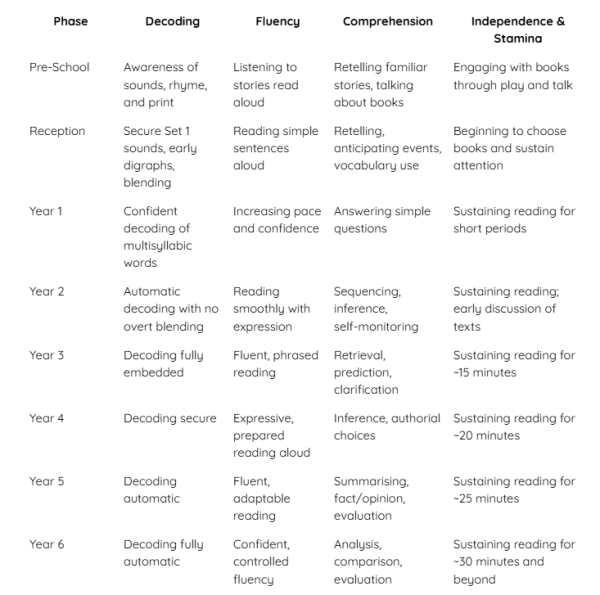
 

Our use of fluency, close reading, and extended reading lessons is carefully matched to children’s stage of reading development.

In Reception and Year 1, teaching is dominated by phonics lessons through Read Write Inc., supported by daily opportunities to hear high-quality texts read aloud. As decoding becomes secure, early fluency work is introduced through repeated reading of simple, fully decodable texts.

In Year 2, fluency lessons become a daily priority. Children move beyond overt blending and are explicitly supported to read with pace, phrasing, and expression. Close reading begins to feature more regularly, using short extracts to support inference, vocabulary development and comprehension monitoring.

In Years 3 and 4, fluency remains explicitly taught alongside an increased emphasis on close reading lessons. Texts are reread for different purposes, enabling pupils to analyse language, structure, and meaning. Extended reading is introduced more frequently to build stamina and sustained comprehension.

In Years 5 and 6, children engage regularly in all three lesson types. Fluency lessons ensure reading remains automatic and expressive, close reading develops analytical and evaluative skills and extended reading builds independence, stamina and enjoyment. At this stage, children are increasingly expected to apply strategies independently and to transfer their skills to unfamiliar texts.

Fluency is developed and monitored through frequent opportunities for children to read aloud. Adults across the school – including trained Teaching Assistants and volunteers – regularly listen to pupils read, ensuring that accuracy, pace, and expression are developing securely.

What is noticed through this regular listening directly informs future text choice, grouping, and the level of challenge pupils encounter. Where needed, texts are revisited and reread to secure fluency before moving on. A range of strategies are used to model and develop fluent reading, including echo reading, choral reading, paired reading and explicit adult modelling.

This approach ensures that fluency is not assumed once phonics teaching ends but is continually strengthened and secured as texts increase in complexity.

At planned points throughout the year, the school also takes part in the ‘Just Read’ initiative, led by Mary Myatt in partnership with the University of Sussex.

During these sessions, children spend extended time reading high-quality, carefully selected texts. The initiative complements our core reading curriculum by:

  • Providing opportunities to read rich, challenging texts in full
  • Modelling sustained attention and reading stamina
  • Allowing pupils to revisit and deepen understanding of a text over time
  • Supporting rich discussion and thoughtful response


Text choices within Just Read are deliberately progressive, ensuring children encounter increasing complexity as they move through the school. These sessions reinforce fluency, comprehension, and reading stamina, while also nurturing a culture of deep engagement and enjoyment of reading.

Home reading is carefully matched to pupils’ reading development to ensure success, confidence and enjoyment.
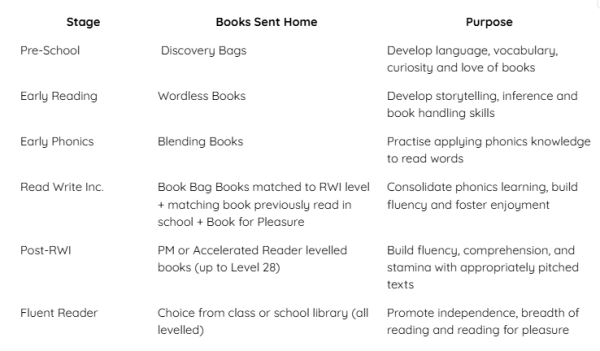


Staff monitor home reading choices to ensure texts remain appropriately challenging while allowing children increasing autonomy.

Children enjoy a range of texts, however the pitch of the text is important too. We can find the level of a book by searching for it on AR Bookfinder. If a match is found, it will tell you the book level, which should be in your child's range. 

A Parent's Guide to Accelerated Reader 

  • Make sure your child has a comfortable, quiet place to sit. Distractions such as TV can make it difficult for children to concentrate.
  • Give the book to your child for five minutes so they can look at it alone. This allows the child to investigate and explore the text and pictures independently before starting to read.
  • Read the title together and ask them to tell you about the story and any questions they may have before beginning.
  • Remember talking about books is as important as reading them.
  • Children need to have enthusiasm for texts so allow them to choose their own  as well as their school reading books.

One of the most important parts of reading is comprehension. If a child decodes fluently, but does not fully understand the story or text, then they struggle to enjoy or appreciate books. It is therefore essential that children have opportunity to discuss what they are reading. One of the more crucial parts of reading is being able to conclude and infer ideas. Open ended questioning such as; ‘why do you think that happened?’ or ‘what makes you think that?’ will help with this. Asking children to tell you why or show you clues in the text/pictures can improve their inference skills dramatically. We enclose a list of potential questions that could be used in a discussion with a child about a book. This is not an exhaustive list but should hopefully give some starting points for discussion that will help children to unpick and fully understand what they are reading.


Sample questions that you could use for book talk:

● Why did you choose this book? What attracted you to it?

● Did you know you anything about this book before you started reading it? What do you think about it now you have read some? Is it how you imagined it would be? Why/why not?

● Could you tell me what’s happened so far (fiction) or what this book is about ( non-- fiction)?

● What has been the most exciting part? Why?

● What could you do if you can’t read a word? What could you do if you can read a word but don’t know what it means?

● Have you come across this word before?

● How did you know how to say it? Are there any clues in the word? Does it look like other words you know?

● Can you work out what that word means? How can you use the rest of the sentence, page or pictures to help you?

● What other word could the author have used that means the same sort of thing?

● Can you tell me what has happened in this chapter/on this page?Why do you think X (a character) did that?

● How could we describe that character? What are they like? How do we know that from what they say and do?

● How you think x (a character) is feeling at the moment? Show me which words/phrases tell us that.

● Why you think Y (an event) happened?

● What do you think will happen next? What makes you think that?

● How you think the author wants us to feel at this moment? How are they trying to do that? What is he/she trying to do here?

● What do you think the purpose of using ____ (word or phrase) is in this paragraph?

● Why did the author choose that title?

● What is the effect of writing in the past/present tense?

Our Reading Spines


For each year group, we have produced a collection of books we aim to read over the year linking to our contexts. These are a store of classic and essential reads for each Year group. Click the links below to access these Year Group Spines:


Useful Links 

Not sure what to read next? Why not explore these websites for recommended reads of the latest literature. 
https://www.thereaderteacher.com/ 

https://www.booksfortopics.com/